

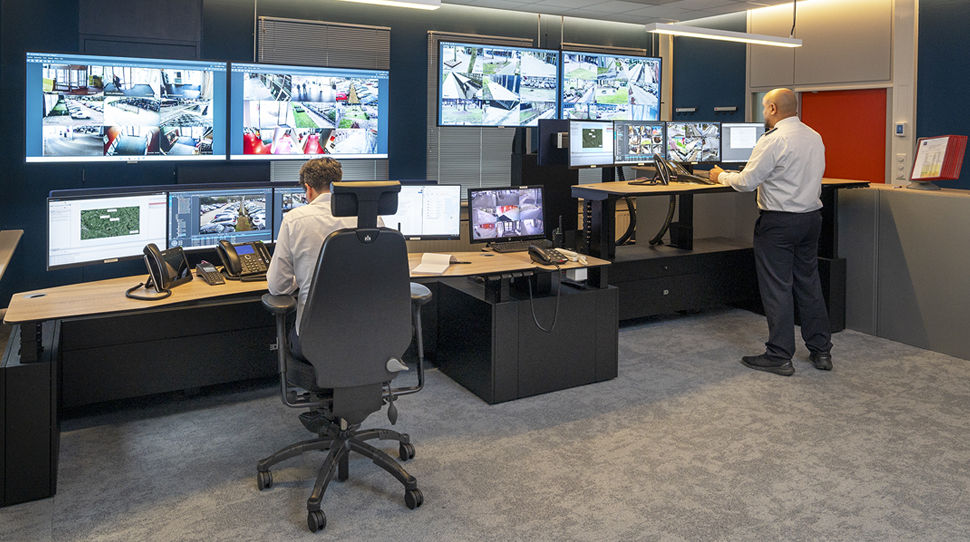
In dispatch and control rooms, where fast and accurate decision-making is key, data plays a crucial role. Ronald Bommerson of TriOpSys and expert in data-driven working, explains in this article how data not only helps predict incidents, but also prevents them.
In essence, data-driven work is about turning raw data into actionable information, particularly for dispatch and control rooms where the amount of available data has increased significantly in recent years. Therefore, the biggest challenge is no longer the lack of data, but creating overview and insight from the abundance of information. To achieve this, you need a structured approach.
Starting the process involves evaluating the current situation and setting clear goals. ‘Faster handling is often the most important operational goal,’ Bommerson explains. ‘For example, if a fire alarm comes in, it needs to be determined quickly whether it is a real fire or a malfunction. That decision determines the follow-up and influences the efficiency of the dispatch and control room.’ In this, data plays an important role by providing dispatchers with the right information so that they can act quickly and appropriately.
Prediction and prevention
Possibly the greatest value of data is its ability to predict and even prevent incidents. By analysing historical data, trends can be identified that help predict future incidents. Bommerson cites burglary prevention as an example: ‘By analysing when, where and under what circumstances burglaries occur, we can make predictions and take preventive measures, such as strategically deploying police capacity.’
Additionally, he points to the role of data in preventing incidents in other sectors, such as lift management. ‘If we know that a certain lift is used much more intensively than others, maintenance is adjusted accordingly. That way, we prevent breakdowns and you establish a piece of calm in the dispatch and control room.’
Infrastructure and technology
Underlying all these applications is the infrastructure needed to use data effectively. According to Bommerson, an open architecture is important, collecting and analysing data from different sources, such as sensors and weather information. ‘We have a digital pinboard where all relevant data is reported and further enriched by smart tools,’ he says. As a result of this approach, dispatchers quickly receive the right information and can respond to incidents.
Although technology is ever-evolving, human factors remain indispensable. ‘You always need a certain degree of intuition to interpret data correctly and make decisions,’ says Bommerson. A good example is the use of AI for violence detection through camera footage. ‘The technology can analyse behaviour and identify possible incidents, but ultimately it is the human who decides whether action should be taken.’
The future of incident management
Data-driven advances over the past five to 10 years have had a major impact on incident management. ‘There is a lot more data available now, and that data is of higher quality and more accessible,’ says Bommerson. The increase in the number of sensors has led to an increase in the number of reports, but these incidents can now be handled faster and more effectively.
Yet there are also challenges, such as filtering false reports and dealing with the so-called waterbed effect, where incidents move to other areas following preventive action. Nevertheless, data-driven working has become the standard within the dispatch and control room, and the possibilities of predicting and preventing incidents are only increasing. And this ultimately leads to a safer society.
Both TriOpSys and CREON play an important role in creating an optimal working environment for operators in control rooms. While TriOpSys provides the smart data analysis tools and open software architectures that enable efficient information flow, CREON delivers ergonomically designed control room and dispatch room solutions that contribute to operators’ comfort and performance. Through their joint efforts, reinforced by their participation in Meldkamerplein, both companies contribute to a more efficient and effective working environment.